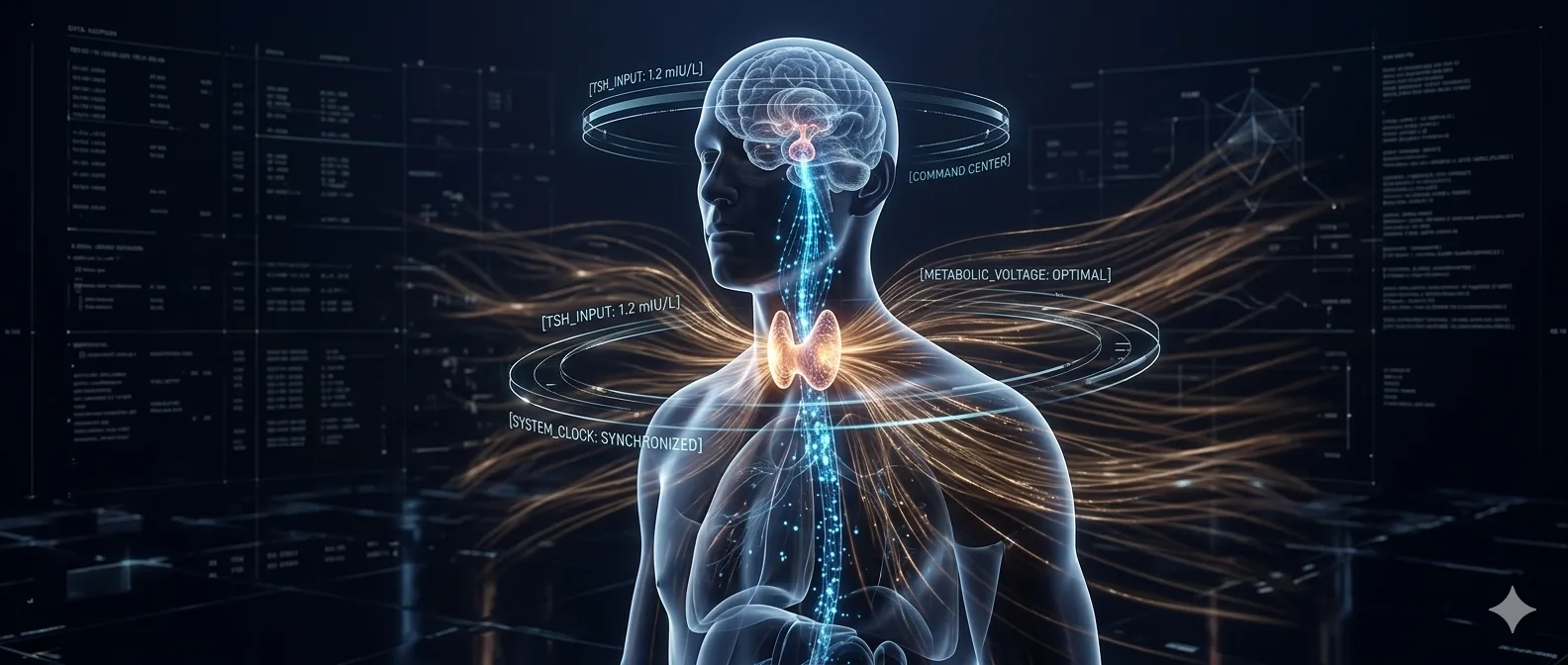
[ ANALYZING THE MASTER CONTROLLER ]
"In the ONDA architecture, TSH is the System Feedback Regulator. Think of your thyroid as the power plant and TSH as the dispatcher in the main office (the Pituitary) that adjusts the voltage based on the system's current load.
We view high TSH not just as a laboratory value, but as a system cry for more energy. When TSH rises, the pituitary is 'shouting' at the thyroid gland, demanding an increase in voltage. If the thyroid doesn't respond, the system enters Underclocking (Hypothyroidism): the heart rate slows, cognitive speed drops, and body temperature falls. Conversely, if TSH is too low, the system is Overclocking, leading to component overheating and rapid resource depletion."
Why do stress and poor sleep raise TSH?
TSH rises under stress because caloric deficits, chronic sleep deprivation, or excess cortisol force the brain to artificially 'downclock' thyroid activity, raising TSH as a protective measure. The system perceives these as 'famine conditions' and shifts the metabolism into survival mode. At ONDA, we learn to distinguish between actual hardware failure (pathology) and temporary software glitches caused by stress.
How does thyroid function affect mental clarity?
The thyroid gland determines the speed of neural transmission. An optimal TSH range (at ONDA, we aim for a 'functional optimum' of 0.5–2.0 mIU/L) ensures maximum mental clarity. Moving outside these parameters leads to 'input lag' in the prefrontal cortex—you lose the ability for deep focus and rapid decision-making.
[ EXECUTION_PROTOCOLS: VOLTAGE_CALIBRATION ]
PROTOCOL_01 > FUEL CHECK (Iodine & Selenium Link)
The Hack: Ensure the system is supplied with critical cofactors—iodine, selenium, and tyrosine.
The Logic: Without these raw materials, the 'power plant' physically cannot produce T3/T4. TSH will rise indefinitely, trying to ignite an empty reactor.
[ STATUS: ACTIVE ]
PROTOCOL_02 > THERMAL TEST (Basal Temp Check)
The Hack: Measure body temperature immediately upon waking.
The Logic: This is the simplest way to verify the actual work of the thyroid under TSH command. A temperature consistently below 36.4°C (97.5°F) is a sign the system is running on low-power frequencies.
[ STATUS: ACTIVE ]
PROTOCOL_03 > STRESS BYPASS (Cortisol Sync)
The Hack: Reduce evening stress load with slow breathing before sleep.
The Logic: Stress hormones and thyroid hormones interact, and one hypothesis is that chronic stress may affect how T4 is converted into the active T3 hormone. This is not an established stress-to-TSH switch, and breathing is not a thyroid treatment: if you have symptoms of a sluggish thyroid, see a doctor for testing.
[ STATUS: ACTIVE ]
[ SYSTEM CORRECTION LOG ]
- •
INPUT_SIGNAL:↑ TSH (> 2.5) / ↓ Energy- •
SYSTEM_STATE:Metabolic Lag / Underclocking Active - •
ACTION:PROTOCOL: MICRONUTRIENT_RELOAD / CORTISOL_DAMPING
- •
- •
INPUT_SIGNAL:↓ TSH (< 0.4) / ↑ Anxiety- •
SYSTEM_STATE:System Overheating / Toxic Overload - •
ACTION:PROTOCOL: THYROID_SCAN / INFLAMMATION_FIX
- •
- •
INPUT_SIGNAL:Morning Coldness / Brain Fog- •
SYSTEM_STATE:Low Basal Metabolism - •
ACTION:PROTOCOL: THERMAL_STIMULATION / SELENIUM_SUPPLY
- •
[ HARDWARE_VALIDATION ]
METRIC: Free T3 / Free T4 + Stable Resting Heart Rate.
STATUS: TRACK_WITH_LAB_TESTS
TSH is your Biochemical Pressure Gauge. By monitoring this metric, you understand how efficiently your system converts fuel into pure energy and intelligence. Managing TSH allows you to sustain a high-drive state without the risk of burning out your biological resources.[ FINALIZE_ANALYSIS ]
Recommended tools
TSH-driven metabolism shows up in glucose patterns long before it shows up in lab work. The instruments that catch it:
- •Levels — deep glucose-curve analytics
- •Nutrisense — human dietitian on metabolic data
- •Zoe — multi-biomarker reset including microbiome and blood markers