[ ANALYZING SYSTEM OVERHEATING ]
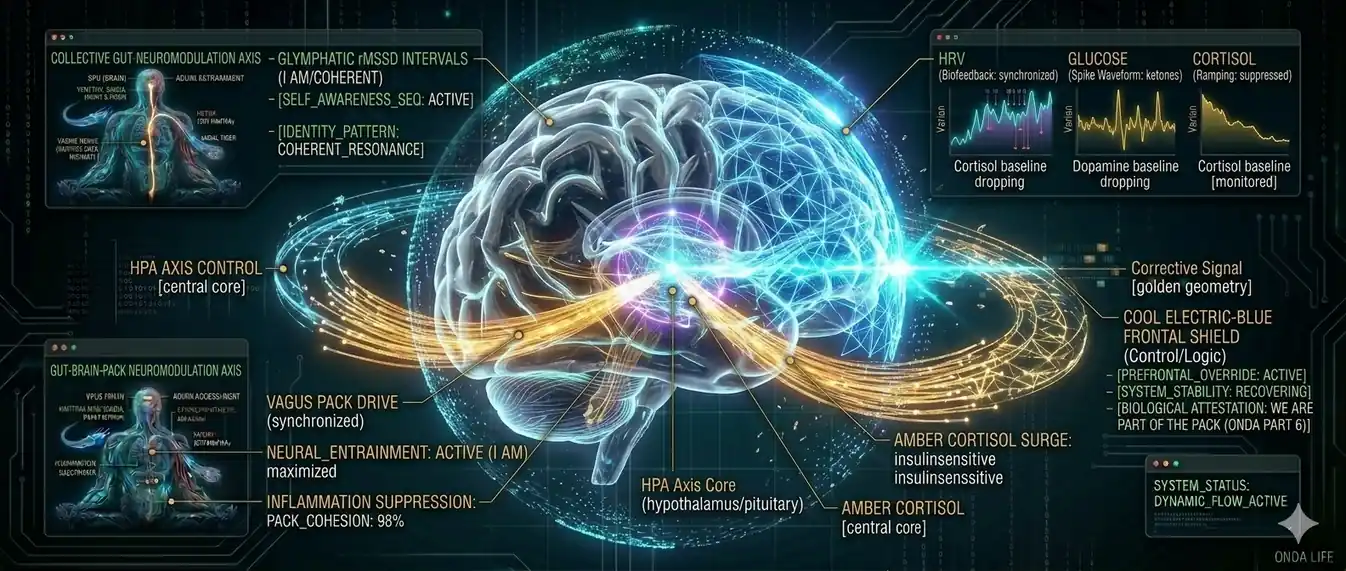
"In the ONDA architecture, aggression is not a character flaw; it is an Emergency Resource Activation Protocol. When external pressure exceeds the current bandwidth of the system, the Hypothalamic-Pituitary-Adrenal (HPA) axis initiates a massive release of Cortisol and Adrenaline.
The primary system error occurs when this protocol gets 'stuck' in the ON position. Chronically high cortisol levels degrade the Prefrontal Cortex—the system's primary 'Processor' responsible for logic and inhibition. The result is a shift into Reactive Management Mode, where every external event is misinterpreted as a direct attack."
[ SECTION 1: CORTISOL — THE SURVIVAL CURRENCY ]
Cortisol is the primary glucocorticoid responsible for glucose mobilization. Its mission: provide an immediate energy surge to the muscles while shutting down 'non-essential' processes (immunity, digestion, regeneration). However, in a social stress context, this energy is often not physically expended, turning into System Noise that manifests as anxiety or uncontrolled aggression.
[ SECTION 2: AGGRESSION AS AN EXPANSION TOOL ]
Aggression is a high-energy state. When managed correctly, it becomes the fuel for breakthroughs and boundary protection. The error arises when aggression becomes an Unmanaged Vector. Our task is not to suppress cortisol, but to learn how to harness its momentum for task execution while maintaining control over the 'Command Line' (the Prefrontal Cortex).
[ EXECUTION_PROTOCOLS: STRESS_BYPASS ]
PROTOCOL_01 > FORCED DECELERATION (Physiological Sigh)
The Hack: Inhale twice through the nose (one long, one short burst), then a long, slow exhale through the mouth. Repeat 3 times.
The Logic: This is one of the fastest hardware-level ways to slow the heart. Slow breathing is associated with higher vagally mediated HRV; whether a longer exhale adds anything beyond slowing the breath is still debated (see vagus nerve). It sends a direct signal to the brainstem: "System is Secure." Adrenaline levels tend to fall quickly.
[ STATUS: ACTIVE ]
PROTOCOL_02 > DISCHARGING STATIC LOAD (Micro-Loading)
The Hack: 30–60 seconds of explosive physical exertion (push-ups, air squats, or a heavy carry).
The Logic: The stress response prepares the body for action. A short burst of physical effort can help discharge the tension it builds; the popular idea that exercise "burns off" cortisol is a simplification.
[ STATUS: ACTIVE ]
PROTOCOL_03 > INTERCEPTING CONTROL (Cognitive Reframing)
The Hack: Verbally label the state: "I am currently in HPA_AXIS_OVERLOAD."
The Logic: Shifts the process from the automatic (Amygdala) to the conscious (Prefrontal Cortex). By naming the process, you create distance, restoring Root Access to behavioral control.
[ STATUS: ACTIVE ]
[ SYSTEM CORRECTION LOG ]
- •
INPUT_SIGNAL:↑ Cortisol / ↑ Muscle Tension- •
SYSTEM_STATE:High Pressure / Reactive Mode - •
ACTION:PROTOCOL: PHYSIOLOGICAL_SIGH
- •
- •
INPUT_SIGNAL:↓ Decision Quality / ↑ Irritability- •
SYSTEM_STATE:Prefrontal Cortex Throttling - •
ACTION:PROTOCOL: SENSORY_DEPRIVATION (5 min silence)
- •
- •
INPUT_SIGNAL:Chronic Stress / Insomnia- •
SYSTEM_STATE:HPA Axis Malfunction - •
ACTION:PROTOCOL: MAGNESIUM_RELOAD + DARK_THERAPY
- •
[ HARDWARE_VALIDATION ]
METRIC: Heart Rate Variability (HRV) as an indirect stress-load signal (ONDA and wearables do not measure cortisol; that needs a lab test).
STATUS: Stress Architecture Under Control. Reactivity Reduced.
Aggression management is not a matter of suppression, but of Energy Management. Once you understand the mechanics of the HPA axis, you cease to be a hostage to hormonal spikes and become the operator of your biological power.[ FINALIZE_ANALYSIS ]
Recommended tools
HPA dysregulation responds to vagal tone work. Three consumer devices that engage the parasympathetic side:
- •Apollo Neuro — all-day vagal modulation for stress regulation
- •Sensate — evening wind-down ritual on the chest
- •Nurosym — auricular tVNS device, studied as an adjunct