[ ANALYZING_SYSTEM_DYNAMICS ]
"Most biohacking protocols were built for linear systems. But the female organism is a Dynamic 28-day Architecture. Attempting to run at maximum clock speed every single day is a system error that leads to hardware burnout.
In the ONDA model, the female cycle is not a limitation—it is a series of Four Unique Work Modes. Each phase has specific system requirements for nutrients, cognitive load, and computational intensity. Synchronizing your output with the current 'Firmware Version' transforms your biology from chaos into a perfectly tuned machine."
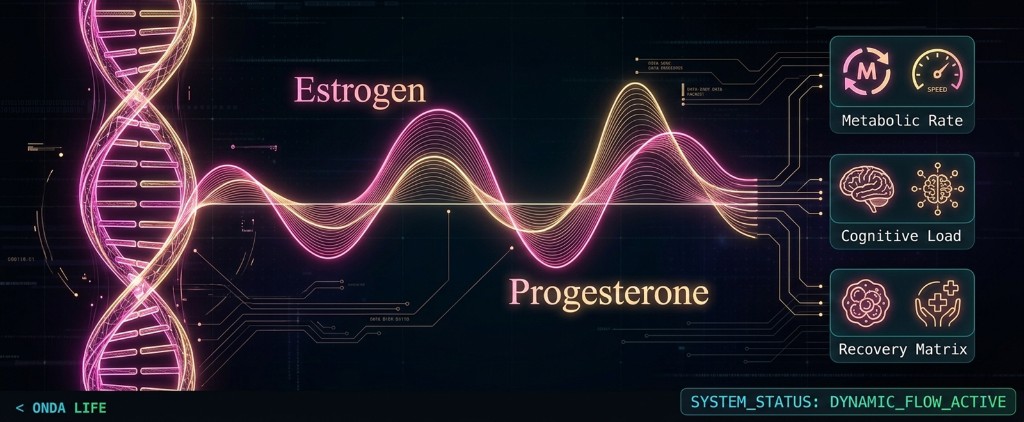
The diagram below maps your hormonal firmware to the four work modes: Metabolic Rate, Cognitive Load, and Recovery Matrix.
How does the menstrual cycle change brain performance?
Brain performance shifts across the cycle, with hormonal firmware updating weekly. In the Follicular Phase (MAX_PERFORMANCE_MODE), the brain is optimized for neuroplasticity and rapid learning. In the Luteal Phase (SYSTEM_MAINTENANCE_MODE), the priority shifts to resource conservation and thermoregulation. Ignoring these toggles is a violation of the system's base code.
How does the menstrual cycle affect metabolism?
Insulin sensitivity and amino acid requirements fluctuate based on estrogen levels. We don't just 'count calories'—we calibrate the fuel mix to match the current metabolic request. This allows for the maintenance of body composition without putting undue stress on the endocrine axis.
[ EXECUTION_PROTOCOLS ]
PROTOCOL_01 > PHASE SYNCHRONIZATION (CYCLE_SYNCING)
The Hack: Schedule high-stakes negotiations and high-intensity interval training (HIIT) during Days 7–14 of the cycle (Estrogen Peak).
The Logic: Estrogen enhances verbal fluency and ligament resilience. This is the window of maximum system uptime.
PROTOCOL_02 > THERMAL MONITORING (BBT_TRACKING)
The Hack: Use a smart ring (Oura/Evie) for daily Basal Body Temperature (BBT) tracking to identify phase transitions with precision.
The Logic: A 0.3–0.5°C rise in temperature signals the switch to RECOVERY mode, where the system requires higher sleep priority and lighter stress and training loads.
PROTOCOL_03 > NUTRITIONAL PATCH (MICRONUTRIENT_LOAD)
The Hack: Increase intake of Magnesium and complex carbohydrates 5 days prior to a new cycle (the 'Progesterone Drop').
The Logic: Pre-emptive nervous system support prevents mood 'glitches' and serotonin crashes, stabilizing the cognitive processor.
[ HARDWARE_VALIDATION ]PRIMARY_DEVICE:[TRACKER: OURA_RING_GEN4 / NATURAL_CYCLES_INTEGRATION]METRIC: Cycle Phase Alignment. The degree of correlation between your activity schedule and your biological rhythm.SECONDARY_DEVICE:[CGM: CONTINUOUS_GLUCOSE_MONITOR]METRIC: Insulin Sensitivity Index. Tracking how carbohydrate tolerance shifts across cycle weeks.SYSTEM_DATA:[BIO_MARKERS: PROGESTERONE_PEAK]METRIC: Whether ovulation occurs, cycle to cycle (progesterone rise).STATUS: TRACK_OVER_WEEKSIllustration — not a measurement
[ FINALIZE_ANALYSIS ]
Cyclical Integrity: Verified. Power Management: Adaptive.