EEG Neurofeedback and Consumer Headsets: What the Evidence Shows
Yakiv Bilenko — editor · Updated October 7, 2026
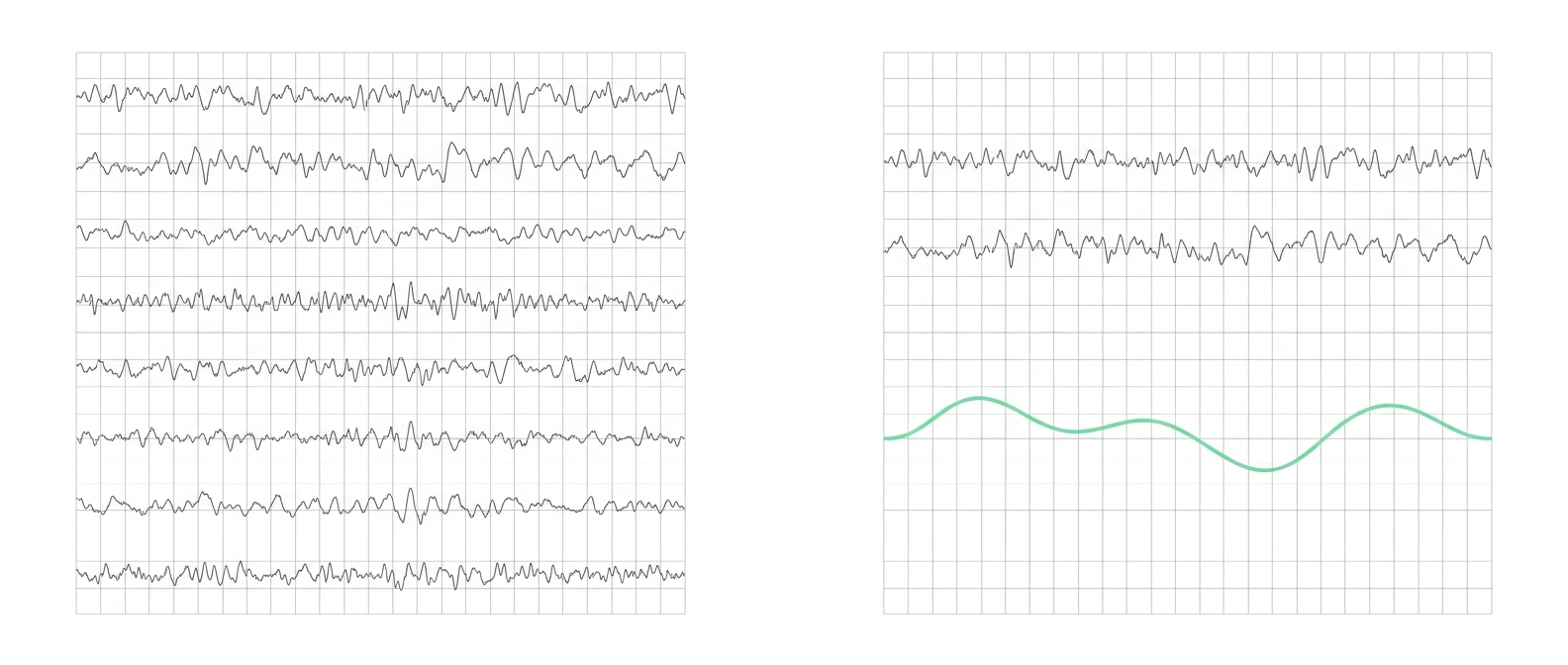
EEG neurofeedback is training in which a person sees or hears their own brain-wave activity, recorded from the scalp, and tries to change it. It is used for meditation feedback and has been studied for ADHD, sleep and mood. Results depend on signal quality, the protocol and blinding. In blinded and sham-controlled trials the specific benefit is small or absent, and consumer focus or calm scores are not validated measures of attention.
Key points
- Neurofeedback feeds back a brain signal recorded from the scalp in real time; clinical systems use a full electrode cap, while consumer headsets use a few dry electrodes.
- Consumer headsets pick up real brain signals, but they are more prone than medical systems to artefacts from blinks, muscle tension and movement.
- Focus and calm scores are each company's own formula; they are not standard scientific measures of attention or relaxation.
- For ADHD, benefits appear mainly in ratings by people who knew the treatment; blinded ratings and a large double-blind trial show little or no specific effect.
- In a double-blind trial in insomnia, real neurofeedback and sham feedback helped equally, which points to expectation and care rather than the brain signal.
- Devices such as Mendi measure blood oxygenation with near-infrared light (fNIRS), a different signal from EEG; the two are not interchangeable.
- Headsets do not diagnose ADHD, depression or epilepsy and are not a replacement for clinical care.
What is EEG neurofeedback?
Electroencephalography (EEG) records tiny voltage changes from the brain through electrodes on the scalp. Neurofeedback turns part of that signal into a sound, a picture or a game in real time, so the person can try to change it. The idea is learning by reward: when the brain signal moves in the target direction, the feedback says so [S6].
Two very different things share the name:
- Clinical neurofeedback. A practitioner uses a full cap of electrodes, often starts with a quantitative EEG (qEEG) recording, chooses a protocol — for example lowering the ratio of slower theta to faster beta activity — and runs many sessions [S4].
- Consumer headsets. Headbands such as Muse or crowns such as Neurosity Crown use a handful of dry electrodes, mostly on the forehead and behind the ears, and turn the signal into meditation sounds or a score.
Not every "brain headset" is EEG. Mendi uses functional near-infrared spectroscopy (fNIRS): light shone through the forehead to estimate changes in blood oxygenation in the front of the brain. That is a slower, blood-flow signal, not electrical activity. The small evidence base on cognitive training with feedback in healthy adults comes mostly from near-infrared studies, not EEG [S13]. Results from one method do not transfer to the other.
How does it work?
The training loop has three steps: record the signal, compute a number from it, and feed that number back. Proponents expect the brain to learn the rewarded pattern and the change to carry over to symptoms or performance.
The weak point is the middle step of the argument. Few experiments separate the effect of feedback from the specific brain signal from everything else that comes with training: attention from a therapist, expectation, motivation and time spent sitting calmly [S6]. A consensus checklist from neurofeedback researchers now asks studies to report control conditions and whether participants actually learned to change their signal [S12].
How is it measured?
Frequency bands. Software splits the EEG into bands by speed. Slower theta activity, the alpha rhythm that grows when the eyes close (see alpha brain waves), faster beta activity during active thinking, and the fastest gamma activity (see gamma and meditation experience). Each band changes with many things at once — eyes open or closed, drowsiness, muscle tension, the task — so a band is not a single mental state. The glossary entries on the alpha state and the theta state give the short definitions.
What consumer headsets can record. In a laboratory task, a low-cost headband picked up classic event-related potentials, brain responses averaged over many repeated trials [S7]. That shows the hardware records real brain activity. It does not show that a live, moment-to-moment score tracks attention.
Signal quality. In a direct comparison with medical systems in five healthy adults, the consumer systems were more prone to artefacts from eye blinks and muscle movement at the forehead, and the medical systems gave better data quality and reliability [S8]. Dry electrodes, jaw clenching, frowning and head movement can all produce signals larger than the brain activity of interest. That study was very small and was run with the makers of the medical systems, so it shows the direction of the problem, not its exact size.
Focus and calm scores. "Focus", "calm", "flow" or "active/neutral/calm" percentages are each company's own formula built on top of the band signals. Their formulas are not published in full, they are not comparable between brands, and we found no peer-reviewed validation of any of them as a measure of attention or relaxation. They are feedback signals, not scientific metrics.
What affects the results?
- Blinding of the rater. In ADHD studies, the effect depends on who rates the symptoms. Parents who know their child had neurofeedback report more improvement than raters who probably do not know [S1] [S3].
- The control condition. Trials against waiting lists look better than trials against active or sham feedback [S1].
- Protocol and equipment. Standard, well-defined protocols showed a small effect where others did not [S2], and a meta-analysis by industry-linked authors, most of them employed by Mensia Technologies, a neurofeedback company, linked higher-quality EEG equipment and more intensive training with larger effects [S3]; the stronger independent data are less favourable [S2] [S4].
- Expectation and care. Motivation, expectation and the attention of the person running the sessions may drive much of the improvement [S5] [S6].
What does the evidence show?
ADHD: established — no meaningful specific effect on blinded outcomes. ADHD is the most studied use. A 2016 meta-analysis of thirteen randomised trials with five hundred and twenty participants found significant effects only in ratings by the least blinded assessors; effects were not significant with probably blinded ratings or against active or sham controls [S1]. A 2025 meta-analysis of thirty-eight randomised trials with 2,472 participants aged five to forty found no significant improvement in probably blinded symptom ratings at the group level; a small effect appeared only in trials of standard protocols, and among laboratory measures only processing speed improved slightly [S2]. A 2019 meta-analysis reads the same evidence more favourably, and it should be read as the view of industry-linked authors: most of its authors were employed by Mensia Technologies, a neurofeedback company, which also funded the first author's doctoral work. It argued that teacher ratings are a poor proxy for blinding and that equipment quality matters [S3]. The stronger independent data do not support that reading: the 2025 meta-analysis above and the double-blind trial below found no specific benefit on blinded or sham-controlled outcomes [S2] [S4].
ADHD against a realistic sham: context-dependent, one large trial. In a double-blind trial of one hundred and forty-four children aged seven to ten, the sham group saw prerecorded EEG with the child's own artefacts superimposed. Both groups improved a great deal, but theta/beta neurofeedback was not better than the sham at the end of treatment or at the later follow-up [S4]. This is one trial of one protocol, but it is the strongest test so far.
Insomnia and sleep: context-dependent to emerging — no added benefit shown. In a double-blind study of twenty-five patients with insomnia, who each had twelve sessions of real and twelve of sham feedback, both conditions improved sleep complaints equally, and objective sleep measures did not change; the authors concluded that the effect was unspecific [S5]. A meta-analysis of randomised trials found no extra benefit of surface neurofeedback on self-reported sleep quality or insomnia compared with control conditions, including cognitive behavioural therapy [S10].
Depression: emerging. A meta-analysis that pooled neurofeedback with HRV biofeedback found reductions in self-reported depression, while noting that research quality has large room for improvement [S9]. Because the two methods were pooled and outcomes were self-reported, this does not show what EEG feedback adds on its own.
Anxiety: unknown. We did not find a sham-controlled meta-analysis of EEG neurofeedback for anxiety that would allow a firm statement. Small studies exist, often combining neurofeedback with other methods.
Attention and cognition in healthy people: emerging. The evidence on cognitive training with feedback in healthy adults rests on very few studies, mostly using near-infrared spectroscopy rather than EEG [S13]. Claims that a consumer headset sharpens focus in healthy users are not supported by large trials.
Meditation with EEG feedback: emerging, single trial. In one randomised trial in healthy adults, daily practice with a consumer EEG meditation headband gave modest benefits on a reaction-time task and on somatic symptoms compared with an active control; secondary measures of attention and well-being showed no training-specific effect, and two co-authors worked for the headset maker [S11]. Hearing when the mind wanders may help some people practise, but this is one small study. How meditation itself relates to body signals is covered in meditation and the autonomic nervous system.
What remains uncertain.
- Whether any subgroup of people with ADHD benefits specifically from neurofeedback [S2].
- Whether feedback from the brain signal adds anything beyond expectation, attention and regular practice [S5] [S6].
- Whether consumer headset scores track attention or relaxation in any validated way.
Does neurofeedback beat sham feedback?
This is the central question, because the person always knows they are training. Sham feedback looks the same but is not linked to the person's own brain signal.
- ADHD: in the largest double-blind trial, no difference from sham [S4]; in pooled trials, no significant effect against active or sham controls [S1].
- Insomnia: real and sham feedback helped equally [S5].
- Interpretation: critics argue that neurofeedback works, when it does, largely as a powerful placebo built on motivation, expectation and care [S6]. Many researchers in the field accept that better-controlled designs are needed and have agreed reporting standards for them [S12].
Does a headset measure your concentration?
No standard measure of concentration comes out of a consumer headset. The hardware records real electrical activity [S7], but much of what reaches a few dry forehead electrodes can be blinks and muscle tension [S8], and the focus or calm number is a company formula without published validation. Use it, if at all, as a cue within your own sessions, not as a reading of your attention.
Is neurofeedback an established treatment for ADHD?
A common claim is that neurofeedback is a proven treatment for ADHD. Blinded and sham-controlled evidence does not support it: effects fade when raters do not know who was treated [S1] [S2], and in a large double-blind trial neurofeedback was no better than sham [S4]. A small effect for standard protocols remains possible [S2].
How does EEG neurofeedback differ from HRV biofeedback?
Both are biofeedback: a body signal is shown back in real time. They differ in what is fed back and how the training works.
- Signal. EEG neurofeedback feeds back scalp electrical activity from the brain. HRV biofeedback feeds back the heart rhythm, which rises and falls with breathing.
- What the person does. In HRV biofeedback the main action is slow, paced breathing, which changes the heart rhythm directly. In EEG neurofeedback there is no equally direct action; the person tries to find a mental state that moves the score.
- Head-to-head evidence. We found no trial that compares the two directly; the depression meta-analysis pooled them rather than comparing them [S9]. What the evidence shows for HRV biofeedback itself is on its own page and is not repeated here.
How the brain represents signals from the body is described in interoception.
Safety and limits
- Recording is low-risk. An EEG or fNIRS headset only reads signals; it does not send current into the head. Skin irritation from sensors is the usual nuisance. Stimulation devices are a different category.
- Not a diagnosis. No consumer headset diagnoses ADHD, depression, epilepsy, sleep disorders or any other condition. A clinical EEG is ordered and read by a specialist.
- Not a replacement for care. Neurofeedback should not replace established care for ADHD, depression or epilepsy, and nothing on this page means "stop your treatment".
- Brain data is personal data. Headset apps store recordings and derived scores, sometimes in the cloud. Read the privacy policy before you start, and treat brain recordings as sensitive.
- Seek medical help for seizures, fainting, sudden confusion, a severe new headache or new weakness, numbness or trouble speaking.
What it does not tell you
- A score is not a state of mind. Focus and calm numbers are proprietary formulas, not validated measures of attention or relaxation.
- Real signal, limited quality. Consumer EEG records real brain activity [S7] but with more artefacts and less reliability than medical systems [S8].
- Improvement is not proof of a specific effect. People often improve during neurofeedback, and so do people receiving sham feedback [S4] [S5].
- EEG and fNIRS are not interchangeable. Evidence about one does not apply to the other [S13].
- Most trials are small and hard to blind [S1] [S12]; the strongest evidence comes from ADHD in children, not from consumer headsets in healthy adults.
Conflicts of interest
Industry ties run through this field. The meta-analysis that read the ADHD evidence most favourably was written mainly by employees of Mensia Technologies, a neurofeedback company, which also funded the first author's doctoral work [S3]. We present it as the reading of industry-linked authors and always next to the stronger independent evidence: the 2025 meta-analysis and the large double-blind trial [S2] [S4]. The consumer meditation-headset trial included two employees of the headset's maker [S11]. The comparison of consumer and medical EEG was funded by a pharmaceutical company and co-authored by employees of the makers of the medical systems that performed better [S8]. The large double-blind ADHD trial was run by neurofeedback practitioners, one of whom holds shares in a neurofeedback clinic group; its result was negative for neurofeedback [S4]. The Muse validation study declared no conflict of interest [S7]. Several authors of the 2025 meta-analysis report fees from pharmaceutical companies outside that work [S2]. Product pages and clinic marketing are not used as evidence on this page.
In ONDA
ONDA does not record EEG or fNIRS and does not measure brain waves, attention or calm. ONDA shows your pulse live during a practice, from the iPhone camera or an Apple Watch; the coherence reading needs an Apple Watch and is ONDA's own feedback measure, not a brain or clinical metric. ONDA is a guided-breathing app with heart-rhythm feedback, not neurofeedback, and it does not diagnose or treat ADHD, depression, insomnia or any other condition. See what ONDA measures.
Educational information, not a diagnosis or medical treatment.
Evidence at a glance
| Claim | Evidence | Limitation |
|---|---|---|
| Neurofeedback rests on the idea that people learn to change a brain signal when it is fed back to them, yet few experiments isolate the feedback from a specific brain signal as the cause of benefit. [S6] | Debated | Critical narrative review; proponents dispute parts of it. |
| A low-cost consumer headband recorded standard event-related brain potentials in a laboratory task. [S7] | Emerging | Event-related potentials are averaged over many trials; this does not validate continuous focus or calm scores. |
| Consumer EEG systems were more prone than medical systems to artefacts from eye blinks and muscle movement, and medical systems gave better data quality and reliability. [S8] | Emerging | Five healthy adults; one shared electrode site compared; co-authors work for the makers of the medical systems. |
| In ADHD, neurofeedback effects were significant in ratings by the least blinded assessors but not in probably blinded ratings or in trials with active or sham controls. [S1] | Established | Children and adolescents; risk of bias unclear in most trials. |
| A newer meta-analysis found no significant improvement in probably blinded ADHD symptom ratings, with a small effect only for standard protocols. [S2] | Established | Group-level result; does not exclude benefit in subgroups not yet identified. |
| An industry-linked meta-analysis found parent-rated but not teacher-rated benefit, and argued that teacher ratings are a poor proxy for blinding. [S3] | Debated | Most authors work for a neurofeedback company. |
| In a double-blind trial in children with ADHD, deliberate theta/beta neurofeedback was not superior to a realistic sham, although both groups improved. [S4] | Context-dependent | One trial, one protocol (theta/beta ratio training), children with a high theta/beta ratio. |
| In a double-blind trial in primary insomnia, neurofeedback and sham feedback improved sleep complaints equally, with no change in objective sleep measures. [S5] | Context-dependent | Small crossover study; one protocol (sensorimotor rhythm). |
| A meta-analysis of randomised trials found no added benefit of surface neurofeedback on self-reported sleep quality or insomnia compared with control conditions. [S10] | Emerging | Few small trials with different main outcomes. |
| Neurofeedback and HRV biofeedback were associated with reduced self-reported depression in a pooled analysis, with low research quality overall. [S9] | Emerging | Pools two different methods; self-report; authors note large room for improvement in quality. |
| In a trial in healthy adults, a consumer EEG meditation headband produced modest benefits on some attention and well-being measures, but not on secondary measures. [S11] | Emerging | Single small trial; co-authors employed by the headset maker; secondary measures showed no training-specific effects. |
| In healthy adults, evidence for cognitive training combined with neurofeedback comes from very few studies, mostly with near-infrared spectroscopy rather than EEG. [S13] | Emerging | Very small evidence base; memory outcomes only. |
| Neurofeedback researchers agreed a consensus checklist to improve the design and reporting of neurofeedback studies, including control conditions. [S12] | Guideline / expert consensus | A methods standard, not outcome evidence. |
Sources
- [S1] Cortese et al. (2016). Neurofeedback for Attention-Deficit/Hyperactivity Disorder: Meta-Analysis of Clinical and Neuropsychological Outcomes From Randomized Controlled Trials. Journal of the American Academy of Child and Adolescent Psychiatry. DOI 10.1016/j.jaac.2016.03.007 · PMID 27238063 · European ADHD Guidelines Group; children and adolescents
- [S2] Westwood et al. (2025). Neurofeedback for Attention-Deficit/Hyperactivity Disorder: A Systematic Review and Meta-Analysis. JAMA Psychiatry. DOI 10.1001/jamapsychiatry.2024.3702 · PMID 39661381 · European ADHD Guidelines Group; several authors report pharmaceutical fees outside the work; one author was an unpaid adviser to an EU-funded neurofeedback study
- [S3] Bussalb et al. (2019). Clinical and Experimental Factors Influencing the Efficacy of Neurofeedback in ADHD: A Meta-Analysis. Frontiers in Psychiatry. DOI 10.3389/fpsyt.2019.00035 · PMID 30833909 · Four authors work for Mensia Technologies (a neurofeedback company), which also funded the first author's PhD; one author was its scientific adviser (full text)
- [S4] Neurofeedback Collaborative Group (2021). Double-Blind Placebo-Controlled Randomized Clinical Trial of Neurofeedback for Attention-Deficit/Hyperactivity Disorder With 13-Month Follow-up. Journal of the American Academy of Child and Adolescent Psychiatry. DOI 10.1016/j.jaac.2020.07.906 · PMID 32853703 · Online first 2020. Investigators include neurofeedback practitioners; one is a minority shareholder in a neurofeedback clinic group (full-text disclosures)
- [S5] Schabus et al. (2017). Better than sham? A double-blind placebo-controlled neurofeedback study in primary insomnia. Brain. DOI 10.1093/brain/awx011 · PMID 28335000 · Small double-blind crossover study in a sleep laboratory
- [S6] Thibault & Raz (2017). The psychology of neurofeedback: Clinical intervention even if applied placebo. American Psychologist. DOI 10.1037/amp0000118 · PMID 29016171 · Critical narrative review
- [S7] Krigolson et al. (2017). Choosing MUSE: Validation of a Low-Cost, Portable EEG System for ERP Research. Frontiers in Neuroscience. DOI 10.3389/fnins.2017.00109 · PMID 28344546 · Validation study by academic users of the Muse headband; authors declare no conflict of interest; funding included an NSERC Engage grant, a programme for industry partnerships (partner not named)
- [S8] Ratti et al. (2017). Comparison of Medical and Consumer Wireless EEG Systems for Use in Clinical Trials. Frontiers in Human Neuroscience. DOI 10.3389/fnhum.2017.00398 · PMID 28824402 · Funded by Biogen; co-authors are employees of the makers of the two medical systems tested (Advanced Brain Monitoring, Neuroelectrics); five healthy adults
- [S9] Fernández-Álvarez et al. (2022). Efficacy of bio- and neurofeedback for depression: a meta-analysis. Psychological Medicine. DOI 10.1017/S0033291721004396 · PMID 34776024 · Pools HRV biofeedback and neurofeedback; self-reported outcomes
- [S10] Recio-Rodriguez et al. (2024). Neurofeedback to enhance sleep quality and insomnia: a systematic review and meta-analysis of randomized clinical trials. Frontiers in Neuroscience. DOI 10.3389/fnins.2024.1450163 · PMID 39568666 · Few small trials; authors declare no conflict of interest
- [S11] Bhayee et al. (2016). Attentional and affective consequences of technology supported mindfulness training: a randomised, active control, efficacy trial. BMC Psychology. DOI 10.1186/s40359-016-0168-6 · PMID 27894358 · Two co-authors are employees of Interaxon, the maker of the Muse headband used in the trial (full text)
- [S12] Ros et al. (2020). Consensus on the reporting and experimental design of clinical and cognitive-behavioural neurofeedback studies (CRED-nf checklist). Brain. DOI 10.1093/brain/awaa009 · PMID 32176800 · Consensus of neurofeedback researchers
- [S13] Matsuzaki et al. (2023). The Effect of Cognitive Training with Neurofeedback on Cognitive Function in Healthy Adults: A Systematic Review and Meta-Analysis. Healthcare. DOI 10.3390/healthcare11060843 · PMID 36981504 · Very few studies, mostly near-infrared spectroscopy
Related
- ScienceHRV Biofeedback: What the Evidence Shows
- ScienceMeditation and the Autonomic Nervous System: What the Evidence Shows
- ScienceInteroception: How the Brain Senses the Body
- GlossaryBiofeedback
- GlossaryAlpha State
- GlossaryTheta State
- ArticleAlpha Brain Waves: Do They Really Unlock Calm, Creativity and Flow?
- ArticleGamma Brainwaves: The Measurable Signature of Meditation Experience
How ONDA Science pages are made: every number comes from one checked list of facts, every claim is mapped to its sources and graded by strength of evidence, and sources need a DOI or PMID (manufacturer documentation is used only for device facts).