Acute Stress and HRV: What Happens and How You Recover
Yakiv Bilenko — editor · Updated October 9, 2026
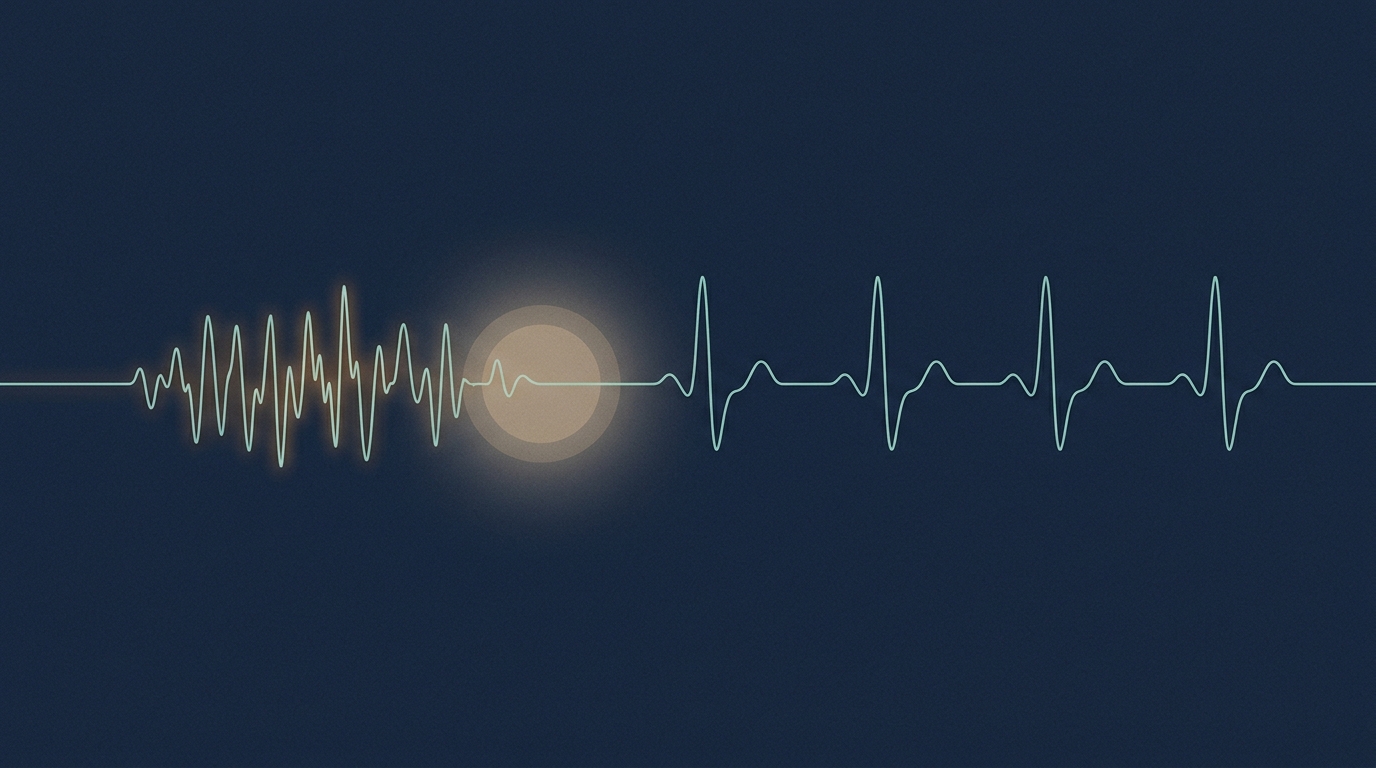
Acute psychological stress, such as mental arithmetic under pressure or a real exam, lowers heart rate variability in controlled studies. Different stressors leave different patterns, so they are not interchangeable. Recovery afterwards is a separate process that varies between people. Breathing before a stress test eased heart rate and anxiety but did not change heart rate variability. Wearables can detect stress in the laboratory; in everyday life the evidence is mixed.
Key points
- In controlled studies, acute mental stress lowered heart rate variability, while pain and noise left different patterns, so different stressors are not interchangeable.
- A real school exam lowered heart rate variability and mood and raised anxiety compared with a normal lesson.
- Recovery after stress is a distinct process; a scoping review maps factors linked with better recovery but does not pool effect sizes.
- In one study, heart rate got used to repeated stress tests while anxiety before each test rose.
- Better fitness went with better resting values, but it did not predict a smaller reaction to a real exam in one study.
- Breathing exercises before a stress test buffered heart rate and anxiety, but heart rate variability and cortisol did not change.
- Wearables detected stress in laboratory tests; in everyday life, physical activity was often confused with stress.
What happens to HRV under acute stress?
Acute stress here means a short, clear challenge: mental arithmetic under time pressure, a public-speaking task, an exam or a live interview. Heart rate variability (HRV) is the beat-to-beat variation in the interval between heartbeats. Under this kind of stress it usually falls, and that is a normal response, not damage. How stress hormones such as cortisol fit in is explained on cortisol and the stress response.
Most of the studies below are single studies, many of them small, so each is labelled as such. Taken together, they show a consistent direction: acute psychological stress lowers vagally mediated HRV. They do not show that one reading tells you how stressed you are. A single low HRV reading does not by itself mean you are stressed or unwell.
Do all stressors look the same?
No. In a laboratory study of 30 healthy adults who each did mental arithmetic, listened to noise and held a hand in cold water, mental stress produced the largest overall drop in HRV, pain from the cold water changed only the average interval between beats, and noise produced no overall change [S1]. When the authors followed HRV in short windows over time, each stressor left its own pattern [S1]. Their conclusion is that different stressors should not be treated as interchangeable versions of "stress" [S1]. This is one small study, but it is a useful warning: a drop in HRV after one kind of challenge says little about another.
How does recovery work?
Recovery after stress is its own process, separate from the reaction itself. A scoping review of 294 studies with 23,533 participants mapped how vagally mediated HRV comes back after acute psychological stress [S2]. Better recovery was associated with resilience, attentional control, habitual use of cognitive reappraisal — reframing how you see a situation — and exposure to nature [S2]. A scoping review maps the literature without quantitative pooling, so it shows which factors have been studied, not how large their effects are or whether changing them speeds recovery. The review also found that studies measure recovery differently, for example over windows of different length and in different postures [S2], so recovery values from different studies are hard to compare.
What happens with repeated stress?
The picture is partial. In a laboratory study of 60 healthy men who each took a standard social stress test in four sessions, heart rate got used to the repeated stress, while anxiety measured just before each test increased [S3]. The body adapted, but the anticipation did not. Men who scored higher on a resilience questionnaire recovered better on RMSSD and SDNN after the stressor, although resilience made no difference to high-frequency power [S3]. This is a single study in healthy men only, so neither half of the result should be quoted without the other.
What about real exams and public speaking?
Real stressors show the same direction as the laboratory. In a study of 67 ninth-grade students, a real mathematics exam lowered HRV and mood and raised state anxiety compared with a normal lesson [S4]. In oral-exam simulations for university students, the exam condition reduced parasympathetic markers whether peers or lecturers ran it, with a stronger shift when lecturers did; afterwards, students felt more competent and their test anxiety fell [S5].
Public speaking has been measured in a real setting, but only in experienced speakers. In 32 experienced science communicators during a live national primetime video interview, total and low-frequency HRV power were higher after the interview than during it or before it [S6]. Speakers rated lower for authority and clarity showed a clear pattern of stress response and recovery; those rated higher varied less [S6]. This is one observational study in experts, and it says nothing about people new to public speaking.
Does fitness buffer the stress response?
Not shown. In the exam study, students with better cardiorespiratory fitness had lower heart rate, higher HRV, better mood and lower anxiety overall, both during the exam and in the normal lesson [S4]. But fitness did not predict how strongly they reacted to the exam once their baseline values were taken into account [S4]. Fitter students started from better resting values; a protective buffer against the reaction itself did not appear. "Not shown" is not the same as "shown not to exist": this was one study, and nobody changed the students' fitness to test it.
Can breathing before a stressful event help?
Partly. In a randomized trial of 66 adults, 22 in each group, people breathed normally, with a long exhale or in a box pattern before a virtual version of a standard public-speaking and mental-arithmetic stress test [S7]. Both breathing techniques blunted the rise in heart rate, state anxiety and salivary alpha-amylase, a marker of stress arousal, compared with normal breathing, and neither beat the other [S7]. HRV, cortisol and cognitive performance did not change in any group [S7]. So breathing before stress eased several stress markers in this single trial, but it did not raise HRV and did not lower cortisol. The other direct comparisons of breathing techniques are on breathing techniques compared.
How does sleep shape the stress response?
Through how stress feels, more than through the heart. In two independent studies of 154 and 212 young adults, worse self-reported sleep was not associated with stronger cardiovascular reactions to standard stress tasks [S8]. It was associated with feeling the stress as more intense and interpreting it as more harmful [S8]. The authors conclude that poor sleep is associated with the psychological, not the physiological, response to stress [S8].
A different question has a different answer. In a small randomized trial of simulated night work, which disrupts both sleep timing and meal timing, vagal HRV markers, including RMSSD, fell in the group that ate at night as well as by day, and did not change in the group that ate only during the day [S9]. That trial studied a disrupted schedule, not how well people felt they slept, so the two findings answer different questions and should not be merged. More on sleep and HRV is on sleep and HRV.
Does a strong stress reaction predict disease?
Not shown for heart disease, and mixed for mortality. In the Multi-Ethnic Study of Atherosclerosis, 957 adults without cardiovascular disease, with an average age of 69 and followed for a median of 8 years, took a standard stress test that recorded blood pressure, heart rate, HRV, salivary alpha-amylase and cortisol [S10]. Stress reactivity was not linked with new cardiovascular disease [S10]. A blunted rise in diastolic blood pressure was associated with earlier death from any cause [S10]. Yet both unusually strong and unusually weak alpha-amylase reactions were associated with lower mortality, a paradox the authors could not explain [S10]. A strong reaction to stress is therefore not a sign of disease, and these population associations say nothing about any one person.
Can a wearable measure stress?
In the laboratory, wearables can detect stress; in daily life, the evidence is mixed. In a laboratory study of 114 healthy volunteers randomly assigned to a social stress test or a control condition, a wrist-worn device measured how much pulse pressure varied; this index was higher in the stressed group, and adding it to heart rate, HRV and cortisol improved the estimate of whether someone was under stress [S11]. Most of the authors work for the company that makes the device, which also funded the data analysis.
Everyday life is harder. In a study of 127 participants who did several mental stress tasks and a range of physical activities, machine-learning models built on a single ECG lead separated mental stress from light physical activity acceptably, but from moderate activity poorly [S12]. The authors conclude that telling stress apart from physical exertion reveals critical limitations of single-sensor ECG approaches [S12]. Many wearables use an optical pulse sensor rather than an ECG, and a meta-analysis of that sensor warns that its agreement with ECG comes mostly from resting conditions and should not be generalised to stress or free-living settings [S13]. A "stress score" on a watch is an estimate in context, not a measurement of stress itself. How wearable HRV is measured is covered on heart rate variability.
What does the evidence show?
By evidence class.
- Established. Studies of recovery after stress measure it in different ways, so their values are hard to compare [S2].
- Context-dependent. Better recovery is associated with resilience, attentional control, reappraisal and nature, as a map of studied factors without effect sizes [S2]; wrist-sensor agreement with ECG comes mostly from resting conditions [S13].
- Emerging. Acute mental stress and real exams lower HRV [S1] [S4] [S5]; stressors leave different patterns [S1]; heart rate habituates to repeated stress while anticipation grows [S3]; breathing before stress eases heart rate and anxiety but not HRV or cortisol [S7]; poor sleep amplifies how stress feels, not the cardiovascular reaction [S8]; wearables detect stress in the laboratory [S11] but confuse it with physical activity in daily life [S12].
- Debated. Stress reactivity and mortality, with associations in opposite directions [S10].
- Unknown or not shown. Fitness as a buffer against the stress reaction [S4]; stress reactivity as a predictor of heart disease [S10]; whether anything you do speeds recovery.
What it does not tell you
- A drop in HRV during stress is not damage. It is the expected response, and recovery is a separate process.
- One low reading is not a stress measurement. A single low HRV reading does not by itself mean you are stressed or unwell, and HRV also changes with movement, sleep, alcohol and illness.
- Studies are small and specific. Several findings come from one study in students, men or experienced speakers.
- No medical conclusions. None of these studies diagnoses a condition, and none shows that a stress reaction predicts heart disease for an individual.
- Calmer is not the same as higher HRV. Breathing before stress eased heart rate and anxiety without changing HRV [S7].
In ONDA
ONDA is built around practice rather than tracking: it offers guided breathing practices with spoken and visual guidance, and ONDA shows your pulse live during a practice, from the iPhone camera or an Apple Watch. With an Apple Watch, or a device that syncs heart data to Apple Health, it compares your HRV, resting heart rate and breathing rate with your own baseline over 14 days. ONDA does not measure stress, shows no stress score and has no study of its own effectiveness; the studies on this page did not test ONDA. The closest evidence here — breathing before a laboratory stress test — eased heart rate and anxiety but did not change HRV [S7]. ONDA does not diagnose or treat any condition. See what ONDA measures.
Educational information, not a diagnosis or medical treatment.
Evidence at a glance
| Claim | Evidence | Limitation |
|---|---|---|
| In a laboratory study of healthy adults, mental arithmetic produced the largest drop in HRV, pain changed only the average interval between beats, and noise produced no overall change. [S1] | Emerging | Single small laboratory study; three specific stressors. |
| The three stressors left distinct time-course patterns in HRV, so they should not be treated as interchangeable proxies of stress. [S1] | Emerging | Single small laboratory study; the time-course differences need replication. |
| A real mathematics exam lowered HRV and mood and raised state anxiety in ninth-grade students compared with a normal lesson. [S4] | Emerging | One study in adolescents at Swiss schools; one exam. |
| In oral-exam simulations, the exam condition reduced parasympathetic markers in both peer-led and lecturer-led formats. [S5] | Emerging | Simulation study in students; sample size is not given in the abstract. |
| A scoping review of acute-stress studies found that better vagal recovery after stress was associated with resilience, attentional control, habitual cognitive reappraisal and exposure to nature. [S2] | Context-dependent | Scoping review: it maps associations and does not pool effect sizes or test interventions. |
| Recovery measurements differ between studies in timing and conditions. [S2] | Established | Describes methods across studies, not a recommended protocol. |
| In men who took a standard stress test four times, heart rate habituated to repeated stress while anxiety before the test increased. [S3] | Emerging | Single study in healthy men only. |
| In the same study, more resilient men recovered better on RMSSD and SDNN after the stressor, but resilience did not affect high-frequency power. [S3] | Emerging | Single study; resilience measured by questionnaire; high-frequency power did not differ. |
| In experienced science communicators during a live television interview, total and low-frequency HRV power were higher after the interview than during or before it. [S6] | Emerging | One observational study in experts only; does not apply to beginners. |
| Better cardiorespiratory fitness was associated with better heart rate, HRV and mood overall but did not predict the response to the exam after controlling for baseline values. [S4] | Emerging | One study; fitness was not changed by an intervention. |
| Before a virtual stress test, box breathing and prolonged exhalation blunted rises in heart rate, state anxiety and salivary alpha-amylase compared with normal breathing. [S7] | Emerging | Single trial; online version of the stress test; one session. |
| In the same trial, HRV, cortisol and cognitive performance did not differ between the three conditions. [S7] | Emerging | Single trial; short measurement window. |
| In two independent studies, worse subjective sleep was not associated with cardiovascular reactivity to stress tasks. [S8] | Emerging | Self-reported sleep over the past month; young adults; cross-sectional associations. |
| Poor subjective sleep was associated with psychological, not physiological, responses to stress. [S8] | Emerging | Associations, not causation; self-reported sleep. |
| In a small trial of simulated night work, the group that also ate at night showed a decrease in vagal markers such as pNN50 and RMSSD, while the daytime-eating group did not. [S9] | Emerging | Small trial; misaligned sleep and meal schedule, not subjective sleep quality or psychological stress. |
| In the Multi-Ethnic Study of Atherosclerosis, stress reactivity was not linked with new cardiovascular disease. [S10] | Emerging | One cohort of older adults; a single laboratory stress protocol at baseline. |
| Blunted diastolic blood pressure reactivity was associated with earlier death from any cause, while both exaggerated and blunted salivary alpha-amylase reactivity were associated with lower mortality. [S10] | Debated | Observational associations with a paradox the authors could not explain; not an individual prediction. |
| In a laboratory stress test with random allocation, a pulse-pressure variability index from a wearable was higher in the stressed group. [S11] | Emerging | Laboratory setting; the study was run and funded by the device maker. |
| Adding that index to heart rate, HRV and cortisol improved the estimate of whether stress was present. [S11] | Emerging | Laboratory setting; not tested in daily life. |
| Models trained on single-lead ECG from participants doing stress tasks and everyday activities separated stress from light activity acceptably but from moderate activity poorly. [S12] | Emerging | One dataset; research-grade ECG, not a consumer wrist sensor. |
| The authors conclude that distinguishing stress from physical exertion reveals critical limitations of single-sensor ECG approaches. [S12] | Emerging | One dataset. |
| Pooled agreement between wrist PPG and ECG HRV comes mostly from resting conditions and should not be generalised to stress or free-living settings. [S13] | Context-dependent | Few pooled studies; healthy, non-clinical populations. |
Sources
- [S1] Villatte et al. (2026). Temporal dynamics of heart rate variability reveal stressor-specific autonomic patterns: a multi-stressor study. Frontiers in Neuroscience. DOI 10.3389/fnins.2026.1832059 · PMID 42591646 · Controlled laboratory study; funded by public research grants (FRQ, NSERC); authors declare no conflicts of interest
- [S2] Roddick et al. (2025). Cardiac vagal recovery following acute psychological stress in human adults: A scoping review. Neuroscience and Biobehavioral Reviews. DOI 10.1016/j.neubiorev.2025.106268 · PMID 40571137 · Scoping review: maps the literature, no quantitative pooling and no effect sizes; COI not checked: no open full text
- [S3] Rösner et al. (2026). Influence of resilience on autonomic nervous system habituation to repeated stress exposure: Insights from heart rate variability and heart rate response. Comprehensive Psychoneuroendocrinology. DOI 10.1016/j.cpnec.2026.100349 · PMID 42088781 · Repeated-measures laboratory study in men only; funded by research institutes and public grants; authors declare nothing to declare
- [S4] Gerber et al. (2026). Does Cardiorespiratory Fitness Predict the Physiological and Psychological Stress Response to a Mathematics Exam in Secondary High School Students?. European Journal of Sport Science. DOI 10.1002/ejsc.70172 · PMID 41949986 · Real exam compared with a normal lesson; authors declare no conflicts of interest
- [S5] Gellisch et al. (2025). Autonomic stress responses in oral examination simulations: Neuroscientific insights from comparing peer-led and lecturer-led approaches. Trends in Neuroscience and Education. DOI 10.1016/j.tine.2025.100270 · PMID 40889828 · Simulation study; sample size not given in the abstract; COI not checked: no open full text
- [S6] Vagni et al. (2025). Psychophysiological correlates of science communicators. PLOS ONE. DOI 10.1371/journal.pone.0320160 · PMID 40138298 · Experienced speakers only; authors declare no competing interests and no specific funding
- [S7] McAllister et al. (2026). Box breathing and prolonged exhalation reduces markers of physiological stress reactivity in response to a virtual trier social stress test. Comprehensive Psychoneuroendocrinology. DOI 10.1016/j.cpnec.2026.100360 · PMID 42388906 · Partly funded by the US Department of Justice (COPS Office); authors declare no competing interests
- [S8] Cook et al. (2026). The Relationship Between Subjective Sleep, Biological Sex, and Cardiovascular and Psychological Reactivity to Acute Psychological Stress. Psychophysiology. DOI 10.1111/psyp.70213 · PMID 41454435 · Two independent laboratory studies; funded by the US National Institutes of Health; no competing interests declared
- [S9] Chellappa et al. (2025). Daytime eating during simulated night work mitigates changes in cardiovascular risk factors: secondary analyses of a randomized controlled trial. Nature Communications. DOI 10.1038/s41467-025-57846-y · PMID 40199860 · Small trial; senior author's consultancies declared as unrelated to this work; other authors declare no competing interests
- [S10] Chauntry et al. (2026). Psychobiological reactivity to acute psychological stress as a predictor of cardiovascular disease and mortality: The Multi-Ethnic Study of Atherosclerosis. Psychoneuroendocrinology. DOI 10.1016/j.psyneuen.2025.107657 · PMID 41135261 · Prospective cohort (MESA); COI not checked: no open full text
- [S11] Shiotani et al. (2025). Standard deviation of pulse pressure measured using wearable devices improves the estimation of acute psychological stress. Scientific Reports. DOI 10.1038/s41598-025-24704-2 · PMID 41266574 · Laboratory study with random allocation to stress or control; five of the six authors are employees of the company that makes the wearable used, which also funded the data analysis
- [S12] Uendes et al. (2026). Electrocardiogram-Based Mental Stress Detection Amid Everyday Activities Using Machine Learning: Model Development and Validation Study. Journal of Medical Internet Research. DOI 10.2196/80450 · PMID 41945645 · Publicly funded (Dutch Research Council); one author owns shares in an ambulatory monitoring company; the others declare no competing interests
- [S13] Xu et al. (2026). Accuracy of photoplethysmography-derived pulse rate variability compared with electrocardiography-derived heart rate variability: a systematic review and meta-analysis. Sensors. DOI 10.3390/s26165192 · PMID 42655500
Related
- ScienceCortisol and the Stress Response: What It Does and What Is Myth
- ScienceBreathing Techniques Compared: What Head-to-Head Studies Show
- ScienceHRV and Heart Rate During Sleep: Why the Night Is the Best Window
- ScienceCan You Trust HRV From a Smartwatch or Ring?
- ScienceThe Autonomic Nervous System: Sympathetic and Parasympathetic
- GlossaryHeart Rate Variability
- ArticleYour HRV Reading Is Low. Now What?
- ArticleThe Nervous System That Never Clocks Out
How ONDA Science pages are made: every number comes from one checked list of facts, every claim is mapped to its sources and graded by strength of evidence, and sources need a DOI or PMID (manufacturer documentation is used only for device facts).