Physiological Coherence: What It Is and What It Isn't
Yakiv Bilenko — editor · Updated October 6, 2026
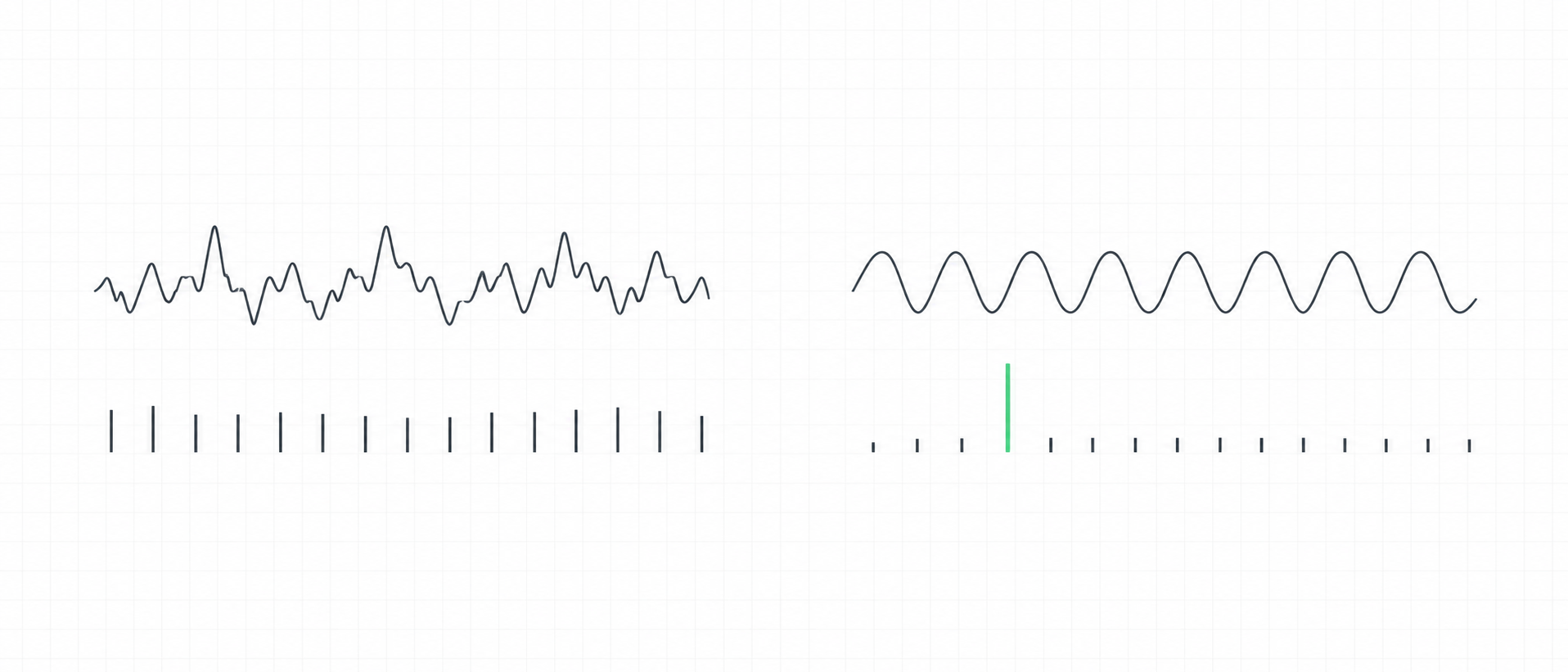
Physiological coherence is a heart-rhythm pattern: heart rate rises and falls in a smooth, almost sine-wave shape at one dominant slow frequency, usually when you breathe slowly near your resonance rate. It is scored as how much of the rhythm's variation sits in a narrow band around that peak. It describes the shape of the rhythm, not the amount of heart rate variability, and it is not a measure of autonomic balance.
Key points
- Coherence describes a smooth, wave-like heart rhythm with one dominant slow frequency, typical of slow breathing near the resonance rate.
- It is scored as the share of the rhythm's variation concentrated around its main peak, so it is a ratio, not an amount of variability.
- High coherence and high heart rate variability are different things: one describes the shape of the rhythm, the other its size.
- Breathing, blood pressure and heart rate come into step during slow breathing; claims that the brain locks into the same phase are not established.
- Coherence is not a reading of the balance between the sympathetic and parasympathetic branches.
- Most coherence research and the scoring method come from authors affiliated with HeartMath, which sells coherence-feedback devices.
- Coherence is a feedback signal during a practice, not a clinical biomarker.
What is physiological coherence?
Physiological coherence is a pattern in the heart rhythm. Heart rate always rises and falls a little from beat to beat. In a coherent state those rises and falls line up into one smooth, almost sine-wave-like oscillation with a single dominant slow frequency, instead of a jumble of faster and slower changes [S1]. The pattern appears most clearly when you breathe slowly, close to your resonance rate, which for most adults is about 5.5–6 breaths per minute (around 0.1 Hz).
The term matters for ONDA because coherence is one of the signals the app shows during a practice. This page sets out what the term measures, how it differs from heart rate variability, and which popular claims about it are not supported.
How is it measured?
Coherence is computed from a short stretch of beat-to-beat intervals. The rhythm is broken down into its frequencies, the highest peak in the slow range is found, and the variation packed into a narrow window around that peak is compared with all the rest [S1] [S2]. The more of the rhythm's variation sits in that one peak, the higher the score.
Two things follow from this design. First, the score is a ratio: it describes how concentrated the rhythm is, not how much it varies. Second, the original scoring method comes from researchers at HeartMath [S1] [S2], and other tools use their own formulas. A coherence score from one app or device cannot be compared with a score from another.
Where does it come from?
Coherence is what the body's breathing-linked rhythms look like when breathing is slow and regular. Heart rate rises with each in-breath and falls with each out-breath, the breath-linked heart rhythm. Slowing breathing towards the resonant frequency makes these oscillations much larger [S4], because the breathing cycle starts to work in step with the blood-pressure reflex that steadies the heart. At that pace, breathing, blood pressure and heart rate move in phase [S3]. The mechanism is explained on how breathing changes HRV and is not repeated here.
Coherence is not the same as HRV
Heart rate variability (HRV) describes how much heart rate varies. Coherence describes the shape of that variation: how orderly and single-frequency it is. The two can move separately, and even the authors of the coherence model describe heart-rhythm patterns that change independently of the amount of HRV [S2].
In practice this means:
- High coherence does not mean high HRV. A small, very regular oscillation can score as highly coherent.
- High HRV does not mean high coherence. A large but irregular variation, with several frequencies mixed together, scores low.
- Slow breathing usually raises both during the practice [S3] [S4], which is why the two are often confused. The difference between them, and when each is useful, is covered in HRV vs coherence.
What does the evidence show?
Established. Slow breathing at an individual's resonant frequency produces large oscillations in heart rate and blood pressure [S4], and breathing, blood pressure and heart rate come into step at that pace [S3]. Coherence is a reasonable way to describe that pattern.
Context-dependent. HRV biofeedback, which trains people to breathe at their resonance rate and often uses a coherence-style display, showed a small to moderate effect across randomised studies, and its authors say more research is needed for particular uses [S6]. Details are on the HRV biofeedback page. That evidence is about the training programme as a whole.
Unknown. Whether the coherence score itself, as a separate number, predicts health, emotional state or performance has not been independently established. Much of the research behind the term and its scoring comes from authors affiliated with HeartMath, which sells coherence-feedback devices [S1] [S2]. The claim that specific emotions show up as specific heart-rhythm patterns is the authors' own model [S2].
Is coherence a measure of autonomic balance?
A common claim is that coherence shows the balance between the sympathetic and parasympathetic branches, or that a high score means the two are in perfect balance. Nothing in how the score is built measures either branch: it is a ratio of spectral power [S1]. The peak it relies on sits in the low-frequency range, and a review of the evidence found that this range is mainly determined by the parasympathetic system and that the LF/HF ratio does not work as an index of autonomic balance [S5]. The two branches are covered on the autonomic nervous system page.
Do the heart, brain and lungs lock into the same phase?
During slow breathing, breathing, blood pressure and heart rate do move in step [S3]. The popular extension is that the brain joins in, so that heart, lungs and brain waves synchronise. HeartMath-affiliated authors describe entrainment between the heart and very slow brain rhythms [S2], but this is asserted in a review by authors with a commercial interest, not shown by independent replication. Coherence is measured from the heartbeat alone; it says nothing about brain rhythms.
Does a coherent heart affect other people?
HeartMath research proposes that magnetic fields from the heart may help synchronise heart rhythms between people in a group, and states it as a hypothesis [S7]. Independent evidence that one person's coherence influences another person's body or mind is not established. The wider heart–brain story is on the heart–brain interaction page.
What it does not tell you
- It is a feedback signal during a practice, not a clinical biomarker. It shows how regular your rhythm is right now, while you breathe a certain way.
- It is not your HRV and not your recovery. A high score during slow breathing says little about your resting HRV or how you slept.
- It is not comparable between people or tools. Breathing pace, body size and the scoring formula all shape the number [S4].
- It is not a reading of emotions, stress hormones or brain activity. Vagal tone cannot be measured directly; HRV measures such as RMSSD reflect vagally mediated changes in heart rate.
In ONDA
ONDA shows a coherence score during a practice. It is derived from your heart rhythm and breathing, needs an Apple Watch, and is not available from the iPhone camera [S8]. It is ONDA's own feedback metric, built with its own formula, and is not comparable with HeartMath or other tools; how it is calculated is described on ONDA's method. For practice guidance, see resonance breathing.
Educational information, not a diagnosis or medical treatment.
Evidence at a glance
| Claim | Evidence | Limitation |
|---|---|---|
| A coherent heart rhythm is defined as a sine-wave-like signal with one narrow, high peak in the low-frequency region of the heart-rate spectrum. [S1] | Context-dependent | Definition proposed by HeartMath-affiliated authors; there is no independent standard for the term. |
| Coherence is scored by finding the highest spectral peak in a set range, taking the power in a narrow window around it, and dividing it by the rest of the spectrum's power. [S1][S2] | Context-dependent | One proprietary-origin scoring method; other tools, including ONDA, use their own formulas, so scores are not comparable across tools. |
| The coherence model's authors state that the pattern of the heart rhythm can change independently of the amount of HRV or heart rate. [S2] | Debated | Stated as a model prediction by authors with a commercial interest; the emotional part is not independently established. |
| Slow breathing at the resonant frequency increases heart-rate oscillations and brings respiratory, blood pressure and cardiac phases into step. [S3] | Context-dependent | Mechanistic review; the downstream benefits it names are partly hypotheses. |
| Paced breathing at an individual's resonant frequency produces large oscillations in heart rate and blood pressure. [S4] | Established | Laboratory studies in healthy adults and asthma patients; the resonant frequency differs between people. |
| The low-frequency part of the heart-rate spectrum, where the coherence peak sits, is mainly determined by the parasympathetic system, and the LF/HF ratio is not a valid balance index. [S5] | Established | Review with reanalysis; applies to resting and laboratory conditions. |
| HeartMath-affiliated authors describe frequency pulling and entrainment between the heart and very-low-frequency brain rhythms. [S2] | Unknown | Asserted in a narrative review by authors with a commercial interest, without independent replication cited for the brain part. |
| A HeartMath-affiliated author proposes that the heart's magnetic field may mediate heart-rhythm synchronisation between people, stated as a hypothesis. [S7] | Unknown | A hypothesis from an author affiliated with a company that sells coherence devices; not independently established. |
| Across randomised studies, HRV biofeedback showed a small to moderate effect, and more research is needed for particular applications. [S6] | Context-dependent | Pools training programmes, not the coherence score as a separate predictor; few studies per outcome. |
| ONDA's coherence score is derived from heart rhythm and breathing during a practice, needs an Apple Watch, and is a feedback metric rather than a clinical biomarker. [S8] | Context-dependent | Product documentation; describes the app, not any health effect. |
Sources
- [S1] Shaffer, McCraty & Zerr (2014). A healthy heart is not a metronome: an integrative review of the heart's anatomy and heart rate variability. Frontiers in Psychology. DOI 10.3389/fpsyg.2014.01040 · PMID 25324790 · Conflict of interest: a co-author is the Chief Scientist of the Institute of HeartMath, which sells coherence-feedback devices
- [S2] McCraty & Shaffer (2015). Heart rate variability: new perspectives on physiological mechanisms, assessment of self-regulatory capacity, and health risk. Global Advances in Health and Medicine. DOI 10.7453/gahmj.2014.073 · PMID 25694852 · Conflict of interest disclosed: the first author is employed by the Institute of HeartMath, which sells heart rate variability feedback devices
- [S3] Sevoz-Couche & Laborde (2022). Heart rate variability and slow-paced breathing: when coherence meets resonance. Neuroscience & Biobehavioral Reviews. DOI 10.1016/j.neubiorev.2022.104576 · PMID 35167847
- [S4] Vaschillo, Vaschillo & Lehrer (2006). Characteristics of resonance in heart rate variability stimulated by biofeedback. Applied Psychophysiology and Biofeedback. DOI 10.1007/s10484-006-9009-3 · PMID 16838124
- [S5] Reyes del Paso et al. (2013). The utility of low frequency heart rate variability as an index of sympathetic cardiac tone: a review with emphasis on a reanalysis of previous studies. Psychophysiology. DOI 10.1111/psyp.12027 · PMID 23445494
- [S6] Lehrer et al. (2020). Heart rate variability biofeedback improves emotional and physical health and performance: a systematic review and meta analysis. Applied Psychophysiology and Biofeedback. DOI 10.1007/s10484-020-09466-z · PMID 32385728 · An erratum was published (Appl Psychophysiol Biofeedback 2021)
- [S7] McCraty (2017). New frontiers in heart rate variability and social coherence research: techniques, technologies, and implications for improving group dynamics and outcomes. Frontiers in Public Health. DOI 10.3389/fpubh.2017.00267 · PMID 29075623 · Conflict of interest: the author is affiliated with the HeartMath Institute (PubMed affiliation), which sells coherence-feedback devices; the field claims are stated as hypotheses
- [S8] ONDA — product documentation: What ONDA measures. What ONDA measures and how it reads your signals.
Related
- ScienceHow Breathing Changes HRV — and Why Slow Breathing Raises It
- ScienceRespiratory Sinus Arrhythmia: How Breathing Shapes Your Heart Rhythm
- ScienceHeart–Brain Interaction: How the Heart and Brain Talk to Each Other
- ScienceHRV Biofeedback: What the Evidence Shows
- ScienceHeart Rate Variability: What It Is, What It Reflects, What It Isn't
- ScienceHow ONDA Measures and Interprets Your Body's Signals
- GlossaryCoherence
- GlossaryHeart Rate Variability
- ArticleCoherent Breathing: The 6-Breaths-a-Minute HRV Sweet Spot
- ArticleResonant Frequency: Finding Your System's Natural Rhythm
- ArticleCardiac Coherence and the 365 Method: France’s Approach to Breathing
- ToolResonance Breathing Rate Finder
How ONDA Science pages are made: every number comes from one checked list of facts, every claim is mapped to its sources and graded by strength of evidence, and sources need a DOI or PMID (manufacturer documentation is used only for device facts).