Illness and HRV: What a Wearable Can and Cannot See
Yakiv Bilenko — editor · Updated October 9, 2026
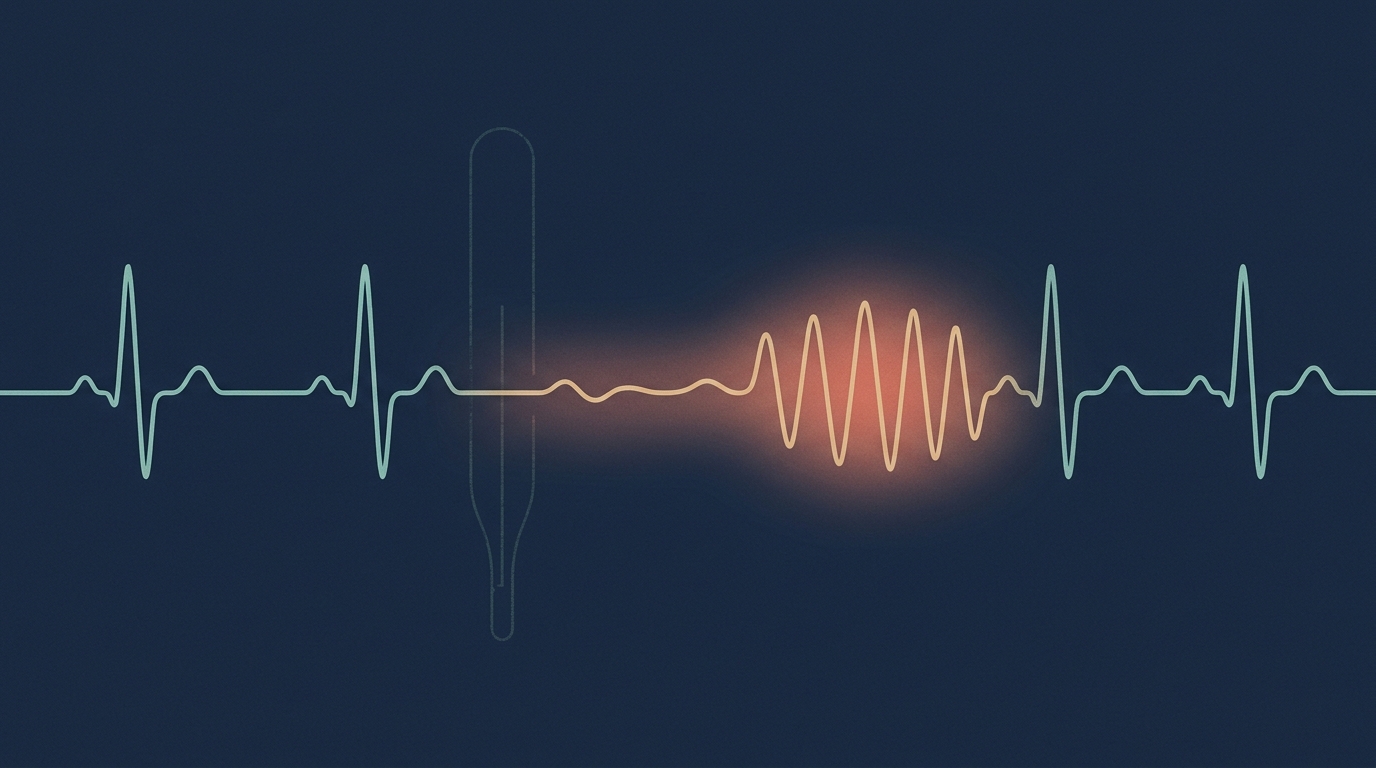
Inflammation and infection tend to lower heart rate variability and raise resting heart rate, but the link is a research finding, not a test. The best-studied early warnings of infection came from a rise in resting heart rate rather than from heart rate variability. Stress, alcohol and travel trigger the same alerts. At most, such a change is a non-specific early signal that the body is under strain. With symptoms, see a doctor, not the watch.
Key points
- In wearable studies, lower heart rate variability, especially SDNN, went together with higher levels of the inflammation marker CRP, and the reviewers call wearable HRV an exploratory biomarker, not a diagnostic tool.
- The best-studied early warnings of infection relied on resting heart rate against a person's own baseline, together with steps and sleep, not on heart rate variability.
- In a prospective smartwatch study, alerts appeared before symptoms in most infected participants, but stress, alcohol and travel triggered alerts too.
- After vaccination, short changes in heart rate variability recovered within a few days in the studies reviewed, with larger changes in women and younger people.
- After an infection, heart rate data added only a little to symptoms for recognising Long COVID in one research study.
- A review of the field says that the ability of wearables to detect viral infections in everyday life has yet to be proven.
- A wearable alert is a non-specific sign of strain; ONDA shows your trend against your own baseline and does not identify illness.
Why can illness move HRV?
Heart rate variability (HRV) is the beat-to-beat variation in the interval between heartbeats. Inflammation, the body's response to infection or injury, is thought to shift the balance of the autonomic nervous system: less vagal activity and more sympathetic activity. That is why researchers ask whether HRV from a wearable can reflect inflammation.
The only systematic review of this question pooled the direction of findings from eleven studies with 2,419 participants [S1]. When the inflammation marker CRP (C-reactive protein) was raised, SDNN was lower in 83% of comparisons [S1]. For RMSSD and inflammatory cytokines the results were mixed and mostly not significant [S1]. Devices that recorded an ECG gave more consistent results than optical pulse sensors [S1].
The reviewers draw a careful conclusion. At present, wearable HRV should be considered "an exploratory or adjunctive biomarker" [S1]. None of the included studies tested how accurately HRV can recognise inflammation [S1]. So the link is real at the level of groups, but it is a research finding, not a test.
What has picked up infection early?
This is the key point of this page: the best-studied early warnings of infection did not run on HRV. They ran on resting heart rate compared with the person's own baseline, together with daily steps and sleep (resting heart rate).
A retrospective analysis from Stanford looked at smartwatch data from 32 people with COVID from a cohort of nearly 5,300 participants [S2]. Most of them had changes in heart rate, daily steps or time asleep around the illness [S2]. An alert system based on a sharp rise in resting heart rate against the personal baseline could have flagged 63% of the COVID cases before symptoms began [S2]. This is a single study with few infected people, and the alerts were simulated afterwards, not sent in real time.
The same group then tested real-time alerts in a prospective study of 3,318 participants, 84 of whom were infected with the coronavirus that causes COVID [S3]. The system used heart rate and steps from smartwatches [S3]. It sent alerts before or without symptoms in 67 of the 84 infected people (80%), and the first signals came at a median of 3 days before symptom onset [S3]. Infection was confirmed by tests, not by the watch.
These are three studies from one research group, so they are not independent confirmations of each other. In the first study, Fitbit promoted the study and donated devices, and the senior author of all three studies co-founded and advises several health-technology companies [S2] [S3] [S4]. Wearable studies of breathing rate during COVID point in a similar direction (breathing rate).
What does an alert actually mean?
A common belief is that a drop in HRV or a device alert means you are getting sick. The prospective study shows why this does not follow. Other respiratory infections, and also events with no infection at all, such as stress, alcohol and travel, triggered alerts too [S3]. So the alert also fired in people who were not infected with the coronavirus, though less often: on average 1.15 alert days per person, compared with 3.42 alert days per person for COVID cases [S3]. An alert says that something deviates from your usual pattern, not what caused it.
A night after drinking is a typical example: HRV falls and resting heart rate rises, with no illness involved (alcohol and HRV). Short sleep, a late meal, hard training and travel move the same numbers (why HRV changes from day to day; HRV and heart rate during sleep). A single low HRV reading does not by itself mean you are stressed or unwell.
What about vaccination?
A vaccine is a planned challenge to the immune system, so it shows what a short immune reaction does to HRV. A systematic review found five observational studies that measured HRV after COVID vaccination [S5]. HRV, mostly RMSSD, changed for a short time and recovered within up to 3 days after vaccination [S5]. In some of the studies the change was larger in women than in men, and in younger than in older people [S5]. The studies were few and their quality was limited, and long-term HRV was not reported [S5]. A short dip in the days after a vaccination fits this pattern. The review does not evaluate vaccination itself, and neither does this page.
What about the time after an illness?
Some people have symptoms for months after an infection, which is called Long COVID. The Stanford group built machine-learning models from heart rate data of 126 people with an acute coronavirus infection [S4]. Adding heart rate features to symptoms gave an improvement of about 5% over symptoms alone in two measures of model accuracy (ROC-AUC and PR-AUC) [S4]. The authors see a possible objective biomarker in this [S4]. It is a single cohort without testing in new people, so the result is a research direction, not a way to recognise Long COVID with a watch.
What does the evidence show?
What we don't know. A review of the field, written by researchers who work with wearable data, says that viral infections can change heart rate, breathing rate, HRV, temperature, activity and sleep before symptoms [S6]. It also says that "the ability of wearable devices to detect viral infections in a real-world setting has yet to be proven" [S6]. Three of its authors were employees of physIQ, a company that analyses wearable data [S6].
By evidence class.
- Emerging. Wearable SDNN tends to be lower when CRP is raised [S1]. A rise in resting heart rate against the personal baseline preceded symptoms in many infections in research cohorts [S2] [S3]. Stress, alcohol and travel trigger the same alerts [S3]. HRV changes after vaccination are short and recover within days [S5]. Heart rate data added little to symptoms for Long COVID in one study [S4].
- Unknown. Whether a consumer wearable can reliably detect a viral infection in everyday life [S6].
What it does not tell you
- A wearable does not diagnose an infection. The reviewers call wearable HRV an exploratory biomarker [S1], and real-world detection has not been proven [S6].
- An alert does not tell you the cause. Infection, stress, alcohol and travel can produce the same change [S3].
- HRV was not the main early signal. The best-studied early warnings relied on resting heart rate, steps and sleep [S2] [S3].
- A normal number does not rule out illness. Many infected people in the studies had no alert [S3].
- It gives no advice on tests, treatment or vaccination.
- Population data are not a prediction for you. The studies describe groups of people; your own pattern may differ.
What can you do with a sharp dip?
If your HRV is clearly below your usual range and your resting heart rate is higher for several days in a row, treat it as a non-specific early signal that the body is under strain. It is a reason to rest and to watch how you feel. If you have symptoms, see a doctor rather than relying on your watch. A single low night is usually not a cause for concern (interpreting HRV).
In ONDA
ONDA builds a personal baseline from nightly values stored in Apple Health — from Apple Watch or another device that syncs heart data there [S7]. The window is 14 days, and ONDA compares each night with your own corridor — the average of your recent nights plus or minus one standard deviation — and flags a night only when it is at least 1.5 standard deviations outside and has changed by a minimum amount: resting heart rate up at least 5 bpm, HRV down at least 15%, breathing rate up at least 2 breaths per minute, with at most one signal every two days. Apple Health records HRV as SDNN, so ONDA's HRV trend is an SDNN trend (your HRV baseline). Such a signal is descriptive: it says that a night is outside your own corridor, not why. An infection, a short night, alcohol or travel can all produce it. ONDA does not identify illness, does not diagnose any condition and does not replace a doctor.
Educational information, not a diagnosis or medical treatment.
Evidence at a glance
| Claim | Evidence | Limitation |
|---|---|---|
| Across wearable studies, SDNN was mostly lower when the inflammation marker CRP was raised. [S1] | Emerging | Vote counting across heterogeneous observational studies; no pooled effect; associations, not cause. |
| Associations between RMSSD and inflammatory cytokines were inconsistent. [S1] | Emerging | Few cytokine studies; different devices and recording lengths. |
| The reviewers consider wearable HRV an exploratory or adjunctive biomarker of inflammation, not a diagnostic tool. [S1] | Emerging | Author conclusion; no study reported diagnostic accuracy. |
| In a retrospective smartwatch analysis, most people with COVID showed changes in heart rate, steps or sleep, and an alert system based on a rise in resting heart rate against the personal baseline could have flagged many cases before symptoms. [S2] | Emerging | Single study with few infected people; retrospective simulation; detection used resting heart rate, steps and sleep, not HRV. |
| In a prospective study, a real-time smartwatch alert system based on heart rate and steps flagged most infections, typically a few days before symptoms. [S3] | Emerging | Single cohort from the same group as the retrospective study; infection confirmed by tests, not by the device; heart rate and steps, not HRV. |
| Stress, alcohol, travel and other respiratory infections also triggered alerts, less often than COVID did. [S3] | Emerging | Event causes self-reported in surveys; alert frequency depends on the algorithm and its thresholds. |
| After COVID vaccination, HRV, mostly RMSSD, changed for a short time and recovered within a few days. [S5] | Emerging | Few observational studies of limited quality; long-term HRV not reported. |
| In some of the studies, the change in RMSSD after vaccination was larger in women than in men and in younger than in older people. [S5] | Emerging | Reported by only some of the studies; small samples. |
| In one cohort, adding heart rate features from a wearable to symptoms improved a machine-learning model for recognising Long COVID only modestly. [S4] | Emerging | Single cohort; no external validation; machine-learning results tend to look better than they turn out in new data; research tool, not a clinical test. |
| A review of the field states that viral infections can change heart rate, breathing rate, HRV, temperature, activity and sleep before symptoms. [S6] | Emerging | Narrative review; mostly pandemic-era studies; some authors employed by a wearable-analytics company. |
| The same review states that the ability of wearables to detect viral infections in a real-world setting has not been proven. [S6] | Unknown | Written before the prospective study above was published in its final form; that study does not test everyday use outside a research cohort. |
| ONDA builds its baseline from nightly Apple Health values and compares each night with the user's own corridor. [S7] | Established | Describes app behaviour only; not evidence for any health claim. |
Sources
- [S1] Siswishanto et al. (2026). Clinical Evidence of Wearable-Derived Heart Rate Variability for Detecting Systemic Inflammation: A Systematic Review. Diagnostics. DOI 10.3390/diagnostics16040538 · PMID 41750686 · Synthesis without meta-analysis (vote counting); no diagnostic accuracy data in the included studies; part of the first author's doctoral thesis; no industry ties declared
- [S2] Mishra et al. (2020). Pre-symptomatic detection of COVID-19 from smartwatch data. Nature Biomedical Engineering. DOI 10.1038/s41551-020-00640-6 · PMID 33208926 · Retrospective analysis, Stanford (Snyder lab); Fitbit promoted the study and donated devices, Google covered cloud costs; the senior author co-founded and advises several health-technology companies (Personalis, Qbio, January, SensOmics, Protos, Mirvie, Oralome)
- [S3] Alavi et al. (2022). Real-time alerting system for COVID-19 and other stress events using wearable data. Nature Medicine. DOI 10.1038/s41591-021-01593-2 · PMID 34845389 · Prospective cohort, same Stanford group as Mishra 2020; funded by NIH grants, gifts and cloud credits (Amazon Web Services, Google); the senior author co-founded and advises several health-technology companies
- [S4] Uwakwe et al. (2025). Longitudinal wearable sensor data enhance precision of Long COVID detection. PLOS Digital Health. DOI 10.1371/journal.pdig.0001093 · PMID 41264615 · Machine-learning modelling in one cohort without external validation; same Stanford group; the senior author co-founded and advises several health-technology companies, the other authors declare none
- [S5] Kwon & Lee (2022). Impact of COVID-19 Vaccination on Heart Rate Variability: A Systematic Review. Vaccines. DOI 10.3390/vaccines10122095 · PMID 36560505 · Small evidence base of observational studies of limited quality; authors declare no conflict of interest
- [S6] Goergen et al. (2022). Detection and Monitoring of Viral Infections via Wearable Devices and Biometric Data. Annual Review of Biomedical Engineering. DOI 10.1146/annurev-bioeng-103020-040136 · PMID 34932906 · Narrative review; three of the seven authors were employees of physIQ, a company that analyses wearable data, and one also consulted for Tempus and received research funding from Janssen
- [S7] ONDA — product documentation: How ONDA works. How ONDA works.
Related
- ScienceWhy HRV Changes From Day to Day
- ScienceWhat a Single HRV Value Can and Can't Tell You
- ScienceHRV and Heart Rate During Sleep: Why the Night Is the Best Window
- ScienceAlcohol and HRV: What a Drink Does to Your Night
- ScienceResting Heart Rate: What It Reflects and How It's Measured
- ScienceResting Respiratory Rate: What It Reflects and How It's Measured
- ScienceHRV Baseline: Why Your Own Normal Matters More Than Any Norm
- GlossaryHeart Rate Variability
- ArticleYour HRV Reading Is Low. Now What?
- ArticleThe Autonomic Glitch: What Long Covid Taught Us About HRV and Breathing
- ToolApple Watch Baseline
How ONDA Science pages are made: every number comes from one checked list of facts, every claim is mapped to its sources and graded by strength of evidence, and sources need a DOI or PMID (manufacturer documentation is used only for device facts).